Springwood resident Phillip Birtles believes that there is an essential connection between people and water. Through his work at Sydney Water, he taps into that connection, strengthening it and contributing to healthier, happier communities while simultaneously improving waterway health.
Key Points:
How we use and manage water is crucial to healthy waterways and happy communities, especially in the face of challenges like climate change and urbanisation.
Built form can have negative impacts on the natural water cycle, leading to stormwater runoff, pollution, erosion, and sedimentation of waterways.
Integrated Water Cycle Management takes a holistic approach to managing water for healthier environments, minimal waste, and better public amenity.
Available at the turn of a tap, mindlessly consumed, flushed and forgotten. Water is essential to life, and yet so often taken for granted. Springwood resident and Integrated Water Cycle Manager at Sydney Water, Phillip Birtles, is working hard to change how people understand the water cycle and to create better systems of water management.
“How we use water is so important because there’s only so much of it,” he said. “Truth is, there is enough water in Sydney, but we have to work harder to set up better systems in urban areas. We need to have a more mature view of water and the water cycle. So much water is being flushed and so much storm water is running off because of all the hard surfaces – we need to get better at capturing that, especially with climate change and urbanisation. But that’s exciting. It requires different thinking. My job is to move the dial on those things.”
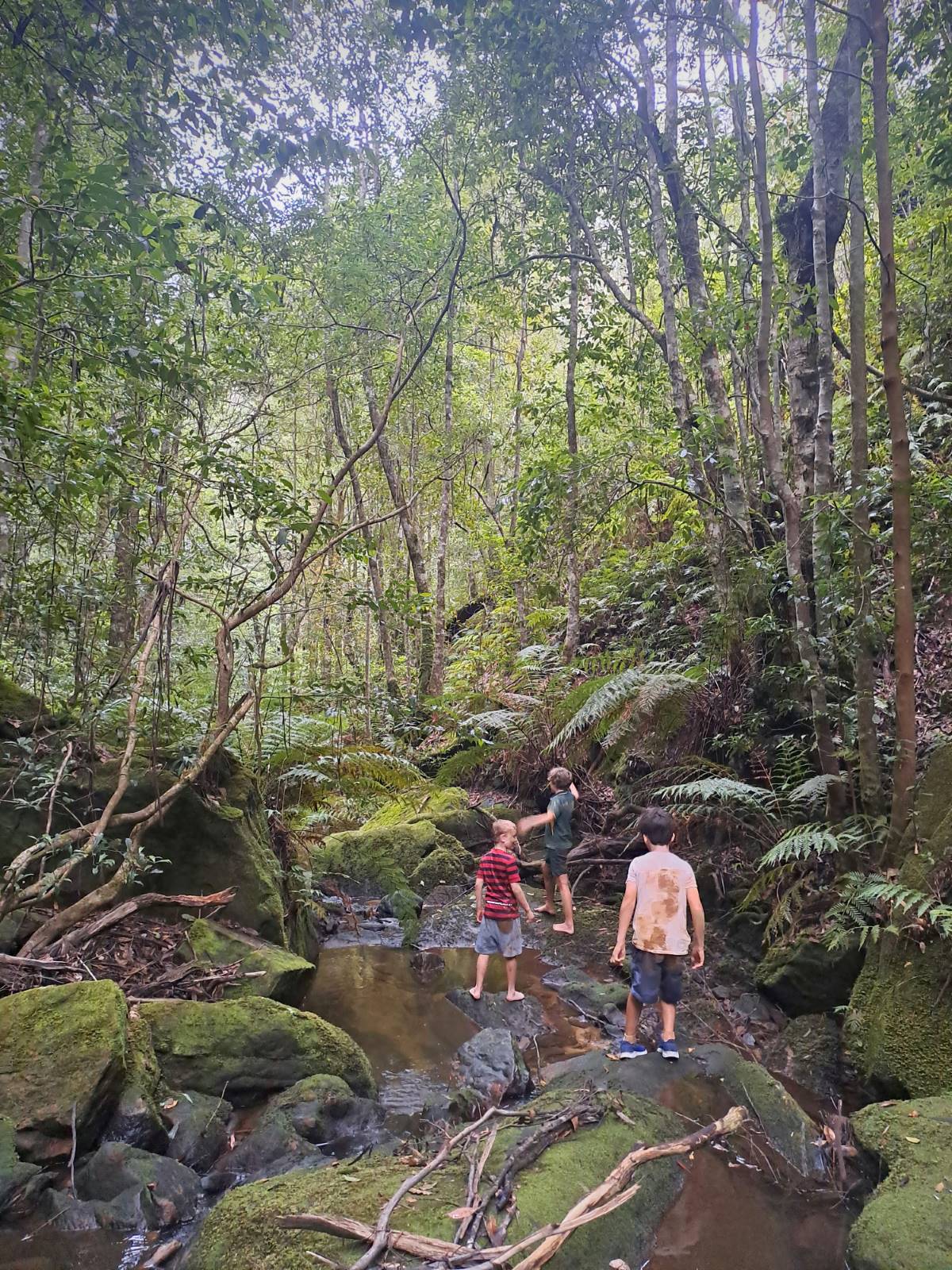
Happy kids enjoying Blue Mountains waterways. (Photo: Belle Butler)
Phillip became interested in rivers and waterway health while studying environmental science at university. He developed a particular interest in urban waterway restoration and later worked at the Department of Land and Water Conservation, promoting Water Sensitive Urban Design concepts and best practice around managing stormwater. “I was trying to protect tiny little streams from development, and I realised the biggest impact was stormwater.”
Water Sensitive Urban Design accepts that conventional urban development can have negative impacts on the natural water cycle. Built-form is full of impervious surfaces that prevent water from doing its natural thing and soaking into the soil. Instead, the water runs off into stormwater drains and watercourses, causing erosion of natural waterways, sedimentation of creeks and rivers, and carrying pollutants with it along the way. Not only is this causing damage to the environment, but it is also enabling the large-scale wasting of water.
Water Sensitive Urban Design aims to integrate the water cycle into urban design, thereby minimising the damage to natural waterways while harnessing, treating and re-using stormwater.
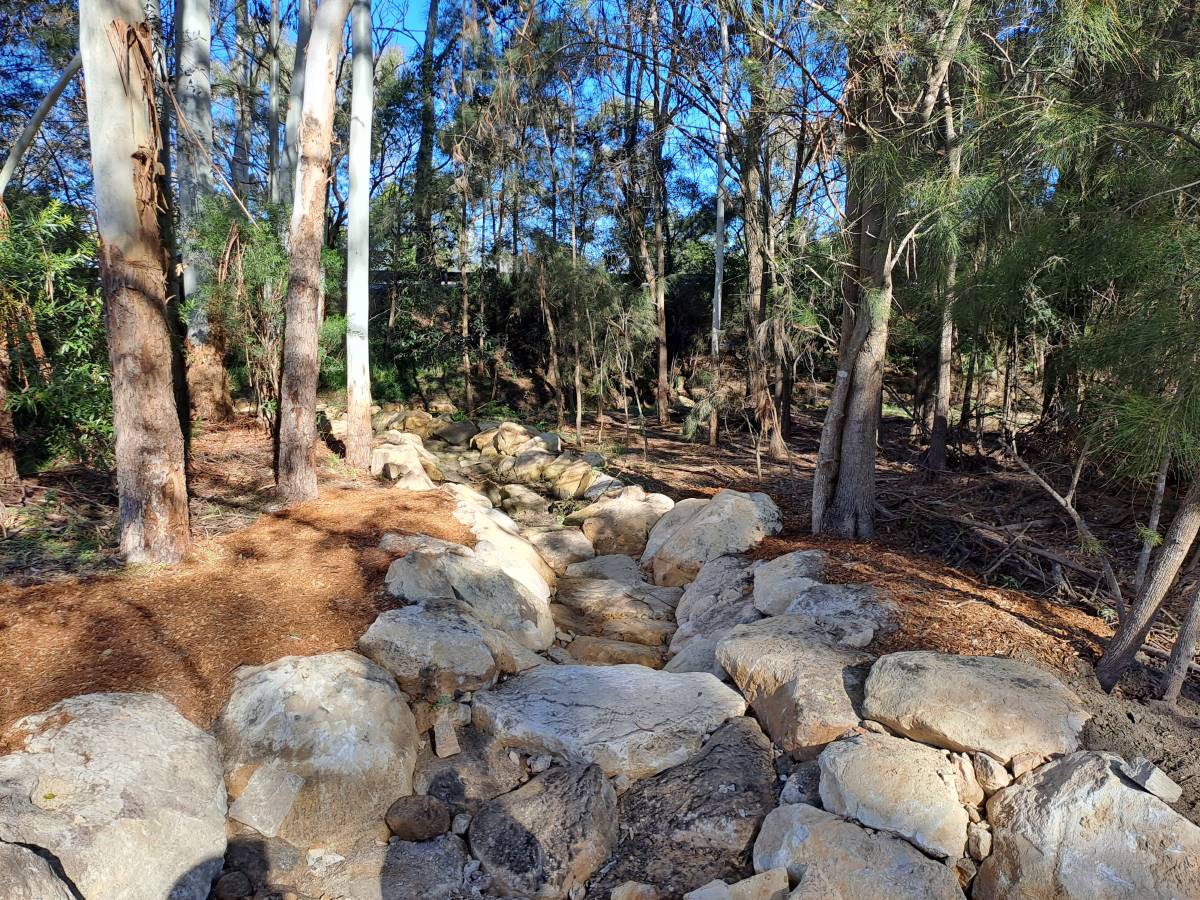
Rock-lined flow paths as part of the Glenbrook Raingardens Project (Photo: Julie Nance)
Sydney Water and Blue Mountains City Council’s jointly funded ‘Glenbrook Raingardens Project’ is an example of this approach. The project involves constructing raingardens and a naturalised stormwater channel with embedded biofilters to remove nutrients from stormwater flows that enter the Hawkesbury Nepean River via Knapsack Creek, thus improving waterway health, creating habitat and improving biodiversity.
At Sydney Water, Phillip’s job has two major focal points: Setting up Integrated Water Cycle Systems in the new development areas around the Western Sydney Airport; and improving water management systems in Parramatta as part of the Make Parramatta River Swimmable Again project.
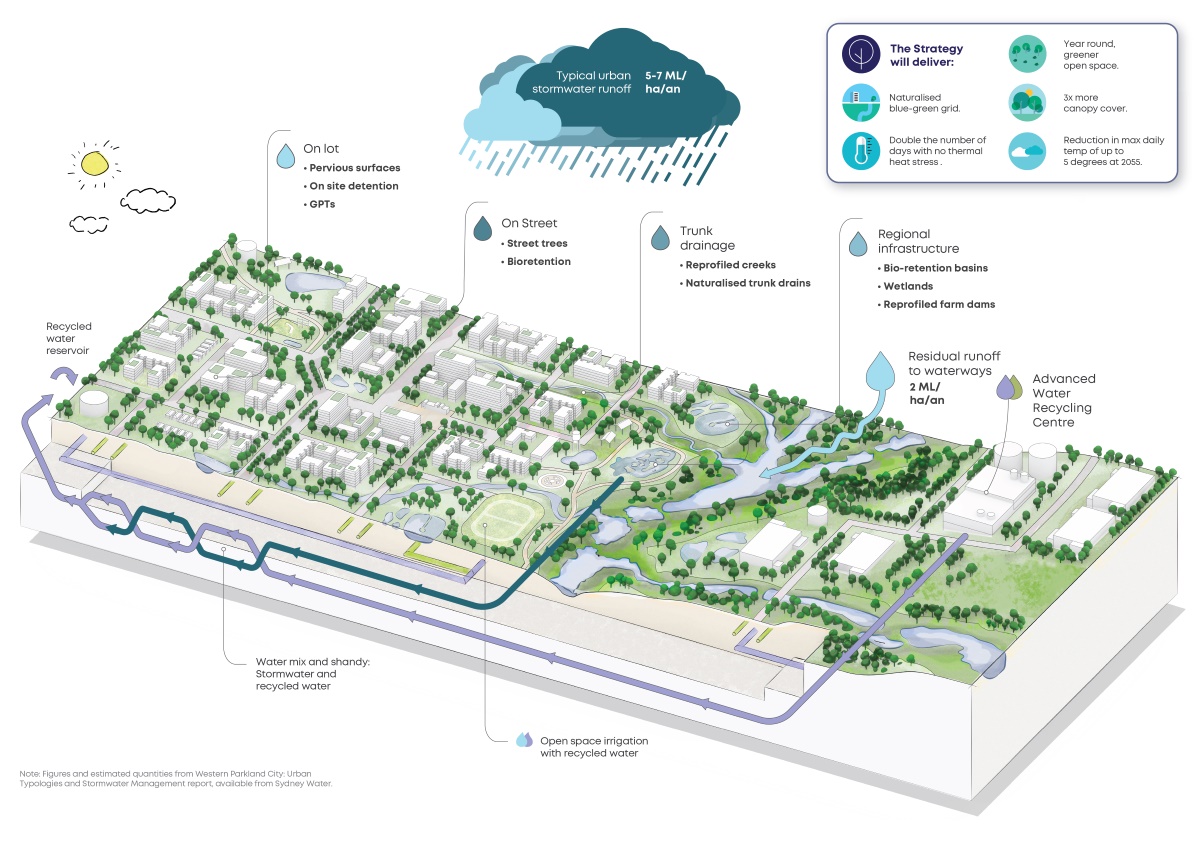
Integrated Water Cycle Management of Western Sydney Parkland City. (Click to enlarge. Image supplied by Sydney Water)
“Integrated Water Cycle Management is about considering the balance of water sources and sinks in the urban contexts at the same time to provide efficiencies and reduce waste. In this way extra benefits can also be identified and considered,” Phillip said.
He explained that Wianamatta (‘The Mother Place’ in Dharug), or South Creek as it’s commonly known, is the most significant waterway that runs through Western Sydney. Already degraded from past and present land-use practices since European settlement, it is also a catchment area that is experiencing rapid urban development. Phillip’s aim is to set up Integrated Water Cycle Systems that improve and protect the health of the natural waterways, manage and utilise water efficiently, and vastly improve the liveability of the area.
“The biggest risk to freshwater streams like Wianamatta is stormwater, causing erosion and then sedimentation,” he said. “One solution is to hold stormwater, harvest as much as possible and put it into a distribution system as a recycled product, mainly used for irrigation and by industry. This reduces the draw down on the dam and protects the system, creating almost unlimited water supply in the urbanised areas of Western Sydney, which are getting hotter and hotter.”
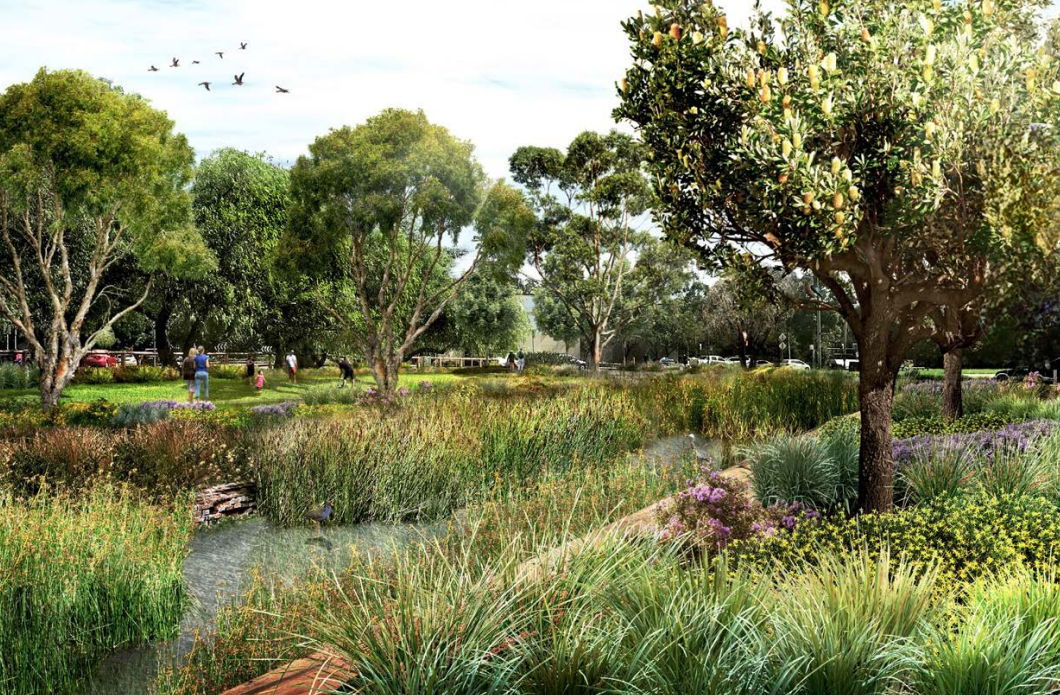
Artist impression of treatment wetlands and trunk drainage channels and creeks (Photo supplied by Sydney Water)
While the science and tech are all there to create and implement these systems, the task is not so simple. “A truly integrated approach to something as complex as the water system is really difficult,” Phillip said. “It requires a holistic approach, and change, which can be hard because people resist change, even when we can see the benefits of it. A lot of what I do is getting different people to talk about it – connecting people and helping them understand. So it’s a people game.”
Connecting people with water is a driving force of Phillip’s work. “Human connection to water is really important,” he said. “It seems that people are drawn to it – real estate value near water is an indicator of that. There are lots of studies that show significant mental health improvements from connection with water, so it’s really important communities have access to clean waterways that aren’t sanitised.”
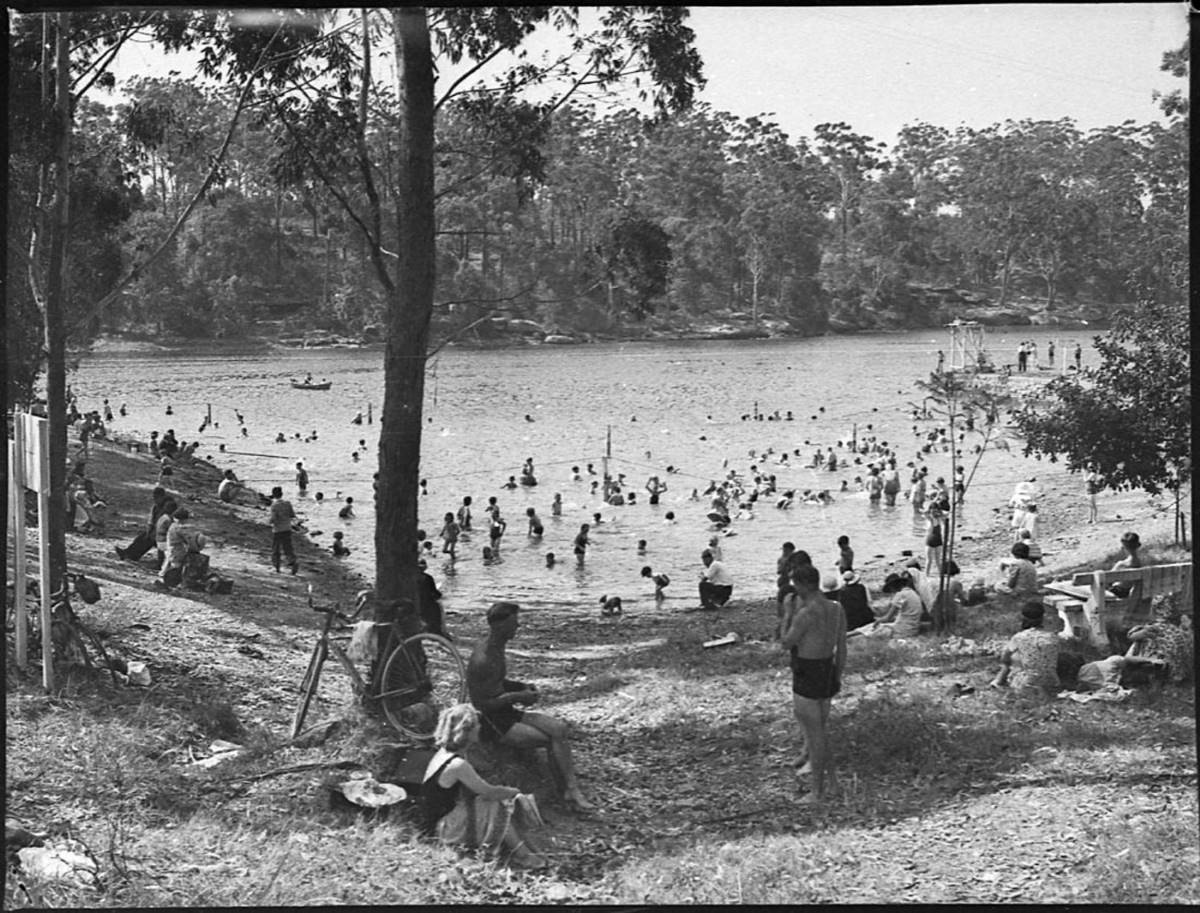
1938 swimmers at Lake Parramatta. (Photo State Library of NSW)
In line with his passion for bringing water and people together, one of the highlights of Phillip’s career has been his involvement in the Parramatta River Masterplan and Make Parramatta River Swimmable Again. “This was the first time we really connected catchment management with a swimming outcome,” he said, “and it was an example of effective community engagement.”
The process involved engaging a PR firm that asked the local community what resonated with them and the Parramatta River. The answer was swimming, and so ensued the Parramatta River Catchment Group’s project, Make Parramatta River Swimmable Again. “We started by asking the people a question, then looked at the data to see if it was possible. We were able to create a management program focussing on an outcome that the community wanted – rather than the usual way of looking at data first, then moving the dial on it to loosely match community outcomes last.”
The project involves rigorous modelling to find out which sites on the Parramatta River are possible to improve and make safe for swimming, the implementation of stronger requirements on stormwater management and sewer system upgrades, auditing major construction sites, and water quality testing as well as real time monitoring at the designated swim sites. “This changed the conversation in Sydney around waterway management,” Phillip said. “It legitimised that you can have a stormwater management outcome and swimming in urban areas.”
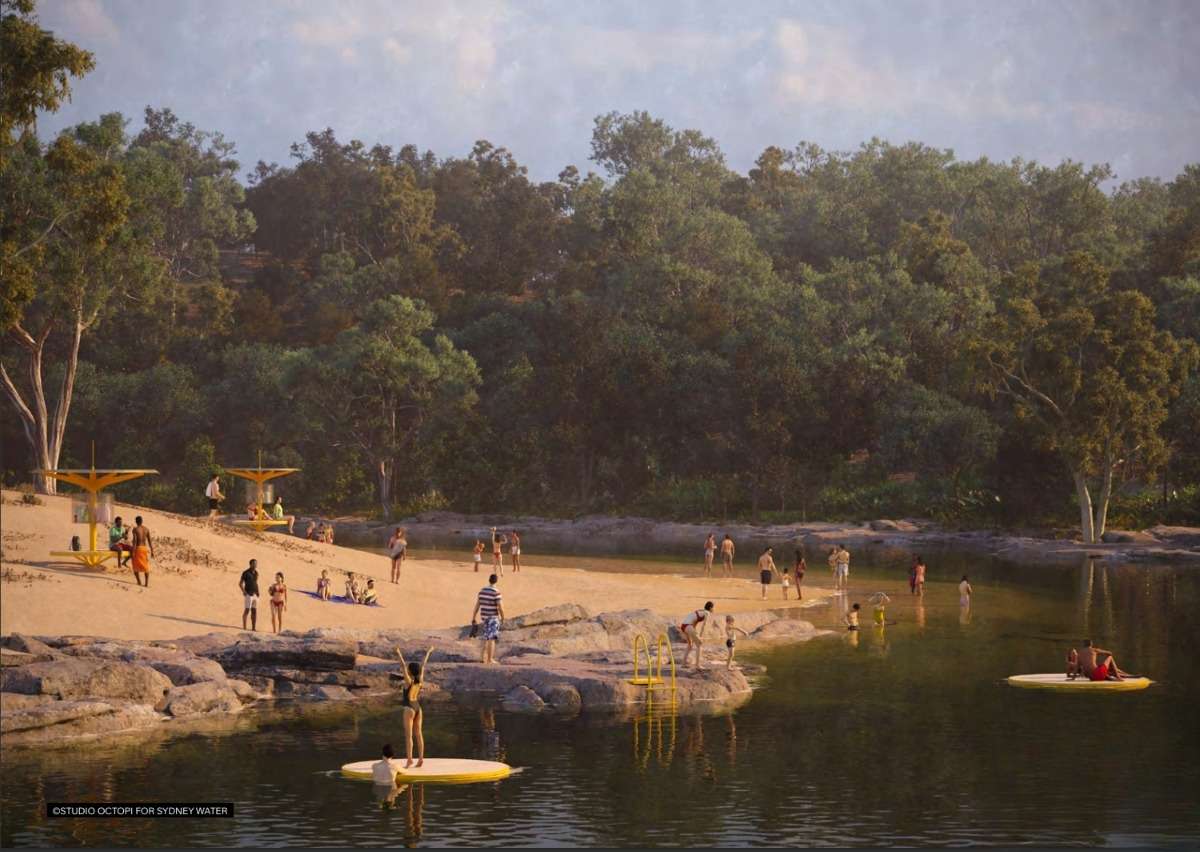
Concept impression of a potential future swimming site. (Image Studio Octopi, supplied by Sydney Water)
In this project, and at the heart of Phillip’s work, is the simple equation that a positive outcome for waterways equals a positive outcome for people. “Improving water quality for swimming means improving waterway health in general. It creates a positive feedback loop – if people care about swimming in water, then people care about clean waterways.”
Take Action:
Individuals can make changes at home to better manage water. Some small actions can make a difference, including:
Installing a rain water tank.
Building a raingarden. Find tips on how to do it yourself here: Building a raingarden
When embarking on building work, being conscious of sediment runoff and install a temporary silt fence.
This story has been produced as part of a Bioregional Collaboration for Planetary Health and is supported by the Disaster Risk Reduction Fund (DRRF). The DRRF is jointly funded by the Australian and New South Wales governments.
Join Andris Heks, Yogic Psychotherapist, winner Best Actor, Blue Mountains, for his workshop to laugh as you never laughed before, as part of a movement to globalise people-bonding cheerfulness through kookaburra laughter contagion as an antidote to distressing world divisiveness.
Purchase your ticket here: https://events.humanitix.com/kookaburra-laughter-workshop
View the trailer and the GoFundMe page here: https://www.gofundme.com/f/globalise-unconditional-love-through-kookaburra-laughter
Key event information: - When? 10:15AM - 2:30PM, Sunday 4 October 2026 (1st day of Daylight Saving - 1 hour forward) - Where? Blue Mountains Planetary Health Centre, 33-39 Acacia St, Katoomba, NSW, 2780 - Fee? $60 or what you can afford - Note: please bring your own lunch
What to expect: - Learn how to stay cheerful for good - Learning the funny, human emulated, communal kookaburra laughter and meditation - How communal kookaburra laughter promotes bonding even amongst strangers - The awesome native treasure of the laughing kookaburra phenomenon - Why Kookaburra Yoga is the ‘most excellent of Yogas` - How communal kookaburra laughter contagion boosts the subtle and gross national product - How you could contribute to the kookaburra laughter contagion
This event is supported by Blue Mountains Planetary Health.
Purchase your ticket here: https://events.humanitix.com/kookaburra-laughter-workshop...
Come along to the Planetary Health Centre this Saturday for the next Skill Share Saturdays event!
This weekend`s agenda:
8:30AM - 10AM | Learn how to use your sewing machine class with Sherlie McMillan
8:30AM | Planetary Health Cafe open, serving Good Fat Pastry and Whisk and Pin
9AM - 10AM | Tai Chi and Qigong class with Virginia Field
10AM - 12PM | Learn how to grow WITH the Upper Blue Mountain permaculture workshop with Leni from Alchemy Farms
10AM - 3PM | Fashion Upcycling Workshop with Sherlie McMillan
10:30AM - 12PM | Learn to make focaccia from scratch with Laura Zucchetti (no experience needed)
1:30PM - 4:30PM | Planetary Health Bushcare with Karen Hising
For more information and to purchase a ticket, please visit the website: https://events.humanitix.com/skill-share-saturdays-at-the-planetary-health-centre...
Plate to Planet: Blue Mountains Food Security Fair 2026
📣HEADLINE SPEAKER📣
Our headline speaker is Julian Cribb AM – a renowned Australian science writer, journalist and author who has spent more than 50 years communicating science, agriculture, climate and global sustainability issues. He is the author of several influential books, including The Coming Famine (2010), Food or War (2019) and How to Fix a Broken Planet (2023), which explore the future of food systems, planetary health and humanity`s long-term survival.
He is widely recognised as one of Australia`s leading voices on global food security and sustainable development.
To register for his talk, and view the rest of the program, visit the website: https://events.humanitix.com/blue-mountains-2026-food-security-fair...
At our next Skill Share Saturdays event on Saturday 5th September, join Laura Zucchetti at 10:30am to learn how to make focaccia from scratch!
Come along for a 90 min class where you`ll mix, rest and stretch your own focaccia dough from start to finish, guided every step of the way. You’ll take home your dough to bake on the day in your own oven.
Sign up to this session, and view the other offerings on the day via this link: https://events.humanitix.com/skill-share-saturdays-at-the-planetary-health-centre...
Plate to Planet: Blue Mountains Food Security Fair 2026
We are pleased to announce that the program and registration for Plate to Planet: Blue Mountains Food Security Fair 2026 is now live!
Follow this link to view the program and register your place: https://events.humanitix.com/blue-mountains-2026-food-security-fair
Key information:
When? Saturday 10 October, 9AM - 4PM
Where? Blue Mountains Planetary Health Centre, Katoomba
Who is it for? Families, gardeners, enthusiasts, community groups and businesses, anyone looking to learn about how to be more resilient through local and sustainable food systems.
What to expect? Talks, workshops, demos, market stalls, family activities, music, food
Is there a cost? Entry to the Fair and Markets is free. Talks and workshops are ticketed (both free and paid) and have limited capacity, so please register in advance.
Program highlights:
🌏Headline talk: The age of renewable Food – Julian Cribb AM 🎋Wild edibles foraging workshops – Diego Bonetto, Eat More Weeds 🏞️The importance of bioregions in uncertain times – Rowe Morrow, Permaculture Matters 🥒Home canning and food preservation workshop – Kirsty Berté, Permaculture Hawkesbury Valley 🏡Designing your own Permaculture Property – Leni Nyssen, Alchemy Farms 🍃Utilising what’s in front of you – Uncle Lex, The Ganya Shed 🪱How to worm farm - BMCC 🎸Live music by Olivia Dustmann 🌾Community crop and seed swap
Tickets are limited so please register your place now: https://events.humanitix.com/blue-mountains-2026-food-security-fair
We are also seeking stallholders for the event. If you are a grower, retailer, community organisation or business that would like to get involved, please reach out to [email protected]!...
Thank you to everyone that joined us at the Planetary Health Centre on Saturday for the first of our Skill Share Saturdays program!
The Centre was a hive of activity all day, and we heard from @alchemyfarms_permaculture, the @ediblegardentrailbluemountains team and Andy Mann. Also thanks to Sherlie McMillan from Greater Blue Mountains Rotary for teaching the Fashion Upcycling workshop, and Virginia Field for the Tai Chi and Qigong class.
The next event will be held on Saturday 1st August - you can register your place here: https://events.humanitix.com/skill-share-saturdays-at-the-planetary-health-centre
🖐Get involved!
Do you have a skill, program or interest that promotes planetary health that you`d be willing to share with members of the local community? We are looking for more workshop and session hosts for our future events.
Join us at the Planetary Health Centre in Katoomba on the first Saturday of every month for Skill Share Saturdays!
Our July program includes: - What to grow in a Blue Mountains climate - Eating for Earth - Tai Chi and Qigong - Fashion upcycling and clothing reuse workshop - How to get involved with the Edible Garden Trail
You are also welcome to bring any surplus seeds or produce for our Crop Swap, or wind down in the Planetary Health Cafe (until 2pm).
If you have a skill that you want to share, or any questions or queries, please contact [email protected]
Visit the website to view the full program of events and register your place.
Join Andy Mann, a 23 year old Lawson local, for their Eating for Earth session 🌏
Eating for Earth is a judgement-free plant-based educational workshop that all types of eaters are encouraged to attend. There will be a presentation about the environmental impact of diets, a discussion section, and best of all, food! The food will be fully plant-based.
Andy wants to help inform our passionate community about how we can better reduce dietary environmental impact.
The session will run from 11AM - 12PM on Saturday 4th July.
Other sessions include: - What to grow in a Blue Mountains Climate - Fashion Upcycling - Tai Chi and Qigong - Bushcare on the Planetary Health site - How to get involved with the Edible Garden Trail
To register your place, visit our website: https://events.humanitix.com/skill-share-saturdays-at-the-planetary-health-centre...
We’re excited to announce the second Blue Mountains Food Security Fair, taking place in Katoomba in October 2026.
This annual event will bring together growers, thinkers, makers, and community members to explore one of the most important challenges of our time: how we grow, share, and sustain food in a changing world.
Across the weekend, we’ll be exploring themes including: - Healthy soil and regenerative systems - Food and human health - Plant-based food futures - Home and community food resilience - Water-sensitive and climate-adapted growing - Indigenous food knowledge and systems - School food systems - Australia’s food procurement - Global food security challenges Expect a dynamic program of inspiring speakers, practical workshops, and hands-on experiences designed to leave you informed, empowered, and connected.
Key information Date: Weekend of 10th October 2026 Location: Blue Mountains Planetary Health Centre, Katoomba, NSW We’ll be announcing speakers and program details soon.
We are also inviting expressions of interest from individuals and organisations who would like to contribute to the program, host workshops, run a stall or partner with us.
Do you struggle making the most of your veggie garden all year round?
Join Leni from @alchemyfarms_permaculture on Saturday 4th July for her Permaculture Workshop: Learn how to grow WITH the Upper Blue Mountains seasons, rather than battling against them.
During the two-hour session, you`ll cover crop selection for different seasons, what to grow from seeds vs seedlings, frost and wind protection, and nurturing your soil with a seasonal cycle.
Register for this and other sessions as part of our Skill Share Saturdays program via this link: https://events.humanitix.com/skill-share-saturdays-at-the-planetary-health-centre...
From Saturday 4 July, we are opening up the Planetary Health Centre for our monthly Skill Share Saturdays program: https://events.humanitix.com/skill-share-saturdays-at-the-planetary-health-centre
Throughout each day, you can expect to find a variety of sessions focused on restoring the health of the planet, in terms of the environment, community and economy.
Sessions at the first event include:
- What to grow in a Blue Mountains climate - Plant-based eating - Tai Chi and Qigong - Fashion Upcycling and clothing reuse workshop
You are also welcome to bring any surplus seeds or produce for our Crop Swap, or wind down in the Planetary Health Cafe (until 2pm).
Visit the website to view the full program of events and register your place: https://events.humanitix.com/skill-share-saturdays-at-the-planetary-health-centre
Registrations essential.
We are also inviting expressions of interest from individuals and organisations who would like to contribute to the program - please reach out to [email protected] if you are interested!...
Belle Butler is a writer, musician and occasional photographer. She likes mix-and-matching these artforms and often explores the same themes through each of them. Her short fiction has been published in numerous Australian literary journals and she recently received a WestWords Fellowship and Mentorship with Delia Falconer for her novel manuscript, ‘River.’ Hopefully it will be published one day.
The Homes for Older Women (HOW) program is a successful community-based solution to the national housing crisis. Since launching in May last year, the Blue Mountains not-for-profit has secured accommodation for 47 older women facing housing insecurity and homelessness.
Support the Future of Solutions-Focused Neighbourhood News